


Less than two kilometers from Cusco’s historic center climbing the cobblestone streets that rise from the San Blas neighborhood there’s an Inca archaeological site most tourists never get to see. Not because it’s hard to find, but because no one tells them about it. Inkilltambo “the house of flowers” in Quechua is one of those gems Cusco still keeps for travelers who take the time to walk a little beyond the usual routes.
Contents
What is Inkilltambo, and why should you visit?
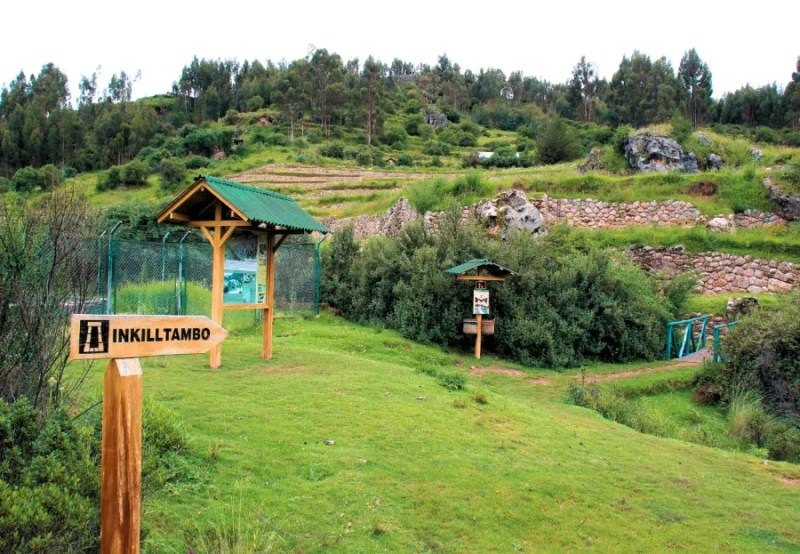
Inkilltambo is an Inca archaeological complex located on the hills surrounding Cusco, on the city’s southeastern side, just a short distance from the historic center. It’s a ceremonial and administrative site that combines finely crafted stonework, water channels, niches, and ritual platforms all surrounded by native vegetation and with sweeping views over the city of Cusco.
What sets Inkilltambo apart from other archaeological sites in the region is exactly its accessibility and its calm. While Sacsayhuamán can receive thousands of visitors a day, at Inkilltambo it’s completely possible to spend an entire morning without seeing more than a dozen people. For travelers who come to Cusco with a bit of time and curiosity, this is one of the best discoveries you can make.

Location: where is the Inkilltambo complex?
The site is in the Chuquipalta area, on the slopes that rise above the San Blas neighborhood, northeast of Cusco’s historic center. Administratively, it belongs to the Cusco District and lies within the buffer zone of the UNESCO World Heritage site. The elevation is around 3,600 meters (11,800 feet) above sea level about 200 meters (650 feet) higher than the Plaza de Armas.
How to get to Inkilltambo on foot from central Cusco
The most direct access is on foot from San Blas. From Cusco’s Plaza de Armas, walk uphill via Hatunrumiyoc Street or Choquechaka to the heart of San Blas, and from there keep climbing through the neighborhood’s cobblestone lanes. The streets gradually narrow until they turn into dirt paths that lead straight to the site. In total, the walk from the Plaza de Armas takes about 30 to 45 minutes at an easy pace.
Access routes: San Blas vs. the Chuquipalta area
There are two main entrances to the site. The San Blas route is the most commonly used and the easiest to follow: it goes up along streets lined with houses and has partial signage. The Chuquipalta route is slightly shorter in distance but requires better familiarity with the area, since the trails aren’t as clearly marked. For a first visit, the San Blas route is the clearest option. If you go with a local guide, the return is often done via Chuquipalta as part of a different loop.

History and architecture of the “Huaca of Flowers”
The name Inkilltambo comes from the Quechua words inkill (flower) and tambo (rest stop or lodge), which can be translated roughly as “lodge of flowers” or “a flower-filled resting place.” In colonial chronicles and in more recent archaeological records, it also appears referenced as a huaca, a term in the Andean world for a sacred place believed to have its own spiritual power. “Huaca of Flowers” is often used as an alternate name.
Inkilltambo as an Inca ceremonial and administrative center
Archaeologists identify Inkilltambo as a mixed-use site: on one hand, it likely served ceremonial functions linked to the worship of water and earth common at Inca sites located near springs. On the other, its proximity to Cusco and the quality of its architecture suggest it may also have served administrative purposes or as a retreat for the Inca elite. Some researchers connect it to the ceque system, the network of sacred lines radiating from the Coricancha that organized ritual space in the Tahuantinsuyo.
Stonework: niches, water channels, and altars
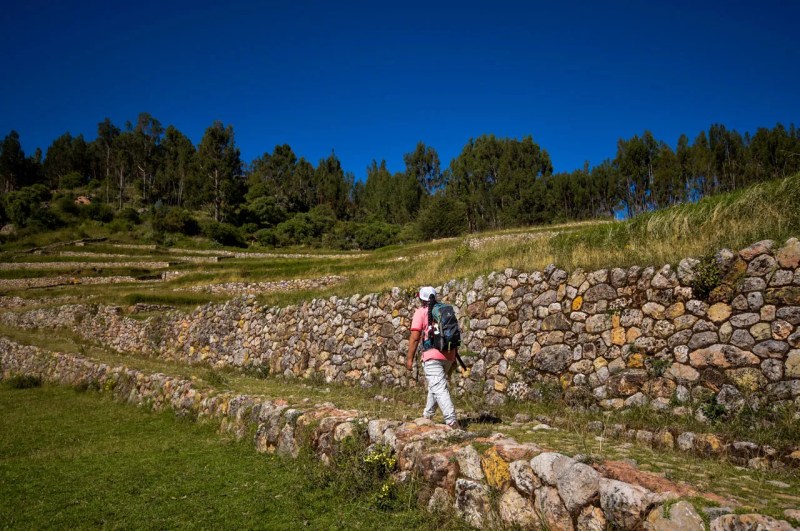
Inkilltambo’s architecture shows several hallmarks of high-level Inca construction. The trapezoidal niches wall recesses used for offerings or sacred objects are precisely carved into living rock and finely cut stone blocks. The water channels are especially striking: they carry water from the area’s natural springs through polished stone structures that have functioned for more than 500 years. You’ll also see stepped platforms and what appears to have been an offering altar aligned using astronomical criteria, although that last point is still being studied.
Inkilltambo’s restoration by Peru’s Ministry of Culture
For many years the site was partially neglected, with some structures buried under vegetation and accumulated soil. In recent years, Peru’s Ministry of Culture carried out cleaning, stabilization, and restoration work that helped recover and highlight several original features. These efforts also improved access and added informational signage. The result is a complex that’s much easier to understand and visit than it was a decade ago though it’s still far from the level of tourist infrastructure you’ll find at sites like Sacsayhuamán or Qenqo.

What to do at the archaeological site
Hiking and nature close to the city
Beyond the ruins themselves, the walk to Inkilltambo and the surrounding area feels like a mini mountain hike. The trail crosses patches of puna vegetation, eucalyptus groves, and wildflowers, and during the rainy season the landscape turns an especially vibrant green. For travelers who don’t have time for longer excursions but still want to walk and get a breath of nature without leaving Cusco, this site is one of the best options around.
Landscape and Inca-architecture photography without crowds
Inkilltambo is one of the few archaeological sites right near Cusco where you can still take photos in peace. The gray stone contrasts beautifully with the surrounding greenery, and from some platforms you can frame direct views of the historic city’s red rooftops with the hills beyond. Clear mornings with low light are ideal. There are no lines, no large tour groups blocking the way, and the silence is part of the scene.
Connecting to other sites: the Temple of the Moon and “Zona X”
Inkilltambo is part of a broader archaeological corridor in the hills surrounding Cusco. Following the trails from the site, you can connect to the so-called Temple of the Moon (also known as Laqo), a natural cave with Inca niches and altars carved into the rock, and to the area popularly known as Zona X or Chakán another group of stone structures and carved rock formations whose exact function is still debated among specialists. This expanded circuit, which can take three to five hours total, is known among Cusco’s archaeological-hiking fans as one of the most interesting and least visited routes in the region.
Practical info for your visit
How much is admission to Inkilltambo?
Unlike Cusco’s larger archaeological sites, Inkilltambo doesn’t have a formal ticket office or a standardized fee system. In practice, access has been free in most recent years. That said, this could change as the Ministry of Culture continues infrastructure improvements, so it’s a good idea to check the current situation before you go or ask at Cusco’s tourist information office. In any case, if there is a fee, it’s typically minimal compared to the general Cusco Tourist Ticket.
Best visiting times to avoid rain
In the wet season (November to March), rain in Cusco usually falls in the afternoons, sometimes starting around midday. If you’re visiting Inkilltambo during that period, the smartest move is to head out early: between 7:00 and 9:00 a.m. skies are often clear and the trails are still dry from the day before. In the dry season (May to October), the schedule is more flexible, though mornings are still best for photo light and cooler temperatures.
Do you need the Cusco Tourist Ticket to enter?
No. Inkilltambo isn’t part of the Cusco Tourist Ticket (BTC) circuits, which cover sites like Sacsayhuamán, Qenqo, Puca Pucara, and Tambomachay, among others. Access is separate and doesn’t require any additional ticket at the moment. That makes it especially appealing for travelers who already paid for the BTC and want to visit more sites without extra cost, or for those traveling on a tight budget.
Safety and gear recommendations
What to bring: hiking shoes, water, and snacks
The trail to Inkilltambo isn’t technically difficult, but it does include steep sections and stretches of loose dirt that can get slippery in the rain. Shoes with good traction are the minimum; running shoes or city sneakers aren’t ideal. Bringing at least half a liter of water per person is enough for the basic route, but if you plan to extend the hike to the Temple of the Moon or Zona X, it’s better to bring double. A light snack and sunscreen round out what you need for a smooth visit.
Tips for hiking safely
The main risk at Inkilltambo isn’t the trail it’s altitude, especially for travelers who just arrived in Cusco. The site sits around 3,600 meters (11,800 feet), and the uphill climb from the center adds extra exertion that an unacclimated body may not tolerate well. It’s best to spend at least one full day acclimatizing in Cusco before doing this hike. Go slowly, breathe steadily, and stop as often as you need to at that altitude, that’s not weakness, it’s the right way to move. If you feel dizzy or develop a strong headache, the right call is to head back down and not push it.
Frequently asked questions about Inkilltambo
How long is the hike from central Cusco?
The climb from the Plaza de Armas to the site takes about 30 to 50 minutes, depending on your pace and how well you’re acclimatized. Exploring the site itself adds another 45 minutes to 1.5 hours. The return to the city center mostly downhill takes about 25 to 35 minutes. Altogether, for a complete round-trip visit from central Cusco, plan on roughly 2.5 to 3 hours at a relaxed pace.
Is it suitable to visit with kids or pets?
With kids, it’s doable, but it’s important to be realistic about the effort required. Children older than eight who are at least somewhat acclimatized can usually handle the climb if you go slowly and take breaks. With very young children or carrying a child the steepness becomes much more challenging. As for pets, the open trails don’t have an explicit restriction, but keep in mind dogs can also be affected by altitude, and at the archaeological site you should prevent them from entering protected stonework areas.
What does the name Inkilltambo mean?
The name comes from Quechua: inkill means “flower,” and tambo refers to a rest stop, lodge, or support point along the roads of the Tahuantinsuyo. The closest translation would be “flower lodge” or “a resting place among flowers.” The local nickname “Huaca of Flowers” comes from the same origin. Some people also connect the name to the abundance of wildflowers that bloom there in the rainy season, when the landscape becomes especially colorful.
Is it dangerous to go without a professional guide?
It’s not dangerous in the strict sense, but going without a guide does have limitations. Signage is only partial, and some side trails can lead into areas where it’s easy to get turned around if you don’t know the terrain. For a basic visit to Inkilltambo itself, most travelers can make it without issues if they have clear directions for the climb from San Blas. If you want to extend the hike to the Temple of the Moon or Zona X, hiring a local guide or going with someone who knows the trails is a reasonable precaution, not so much for physical danger but to avoid wasting time wandering around the hills.

