


The Classic Inca Trail is one of the five most renowned trekking routes in the world. It is not just a path to Machu Picchu, but a four-day journey along pre-Hispanic trails that cross cloud forests, different ecological zones, remote archaeological sites, and mountain landscapes that cannot be seen from any other point in the region. Reaching the citadel on foot through the Sun Gate at sunrise on the fourth day is one of those experiences travelers remember for a lifetime.
Contents
Essential facts before you begin
The trek covers approximately 44 kilometers over 4 days and 3 nights of camping. It begins at kilometer 82 of the railway line, known as Piskacucho, at 2,680 meters above sea level, and ends at the Machu Picchu citadel at 2,430 meters. The highest point on the entire route is the Warmiwañusca Pass, popularly known as Dead Woman’s Pass, at 4,215 meters above sea level. It is the most demanding section of the second day and the point that determines whether your body is properly acclimatized to continue.
The difficulty of the Inca Trail is classified as moderate to challenging. It does not require technical climbing skills, but it does demand real physical fitness, especially cardiovascular endurance and leg strength to handle the original stone steps and the accumulated altitude changes over the four days.

Permits: the first and most urgent step
Access to the Inca Trail is regulated by the Peruvian government through the National Service of Natural Protected Areas (SERNANP). Only 500 permits are issued per day in total, of which approximately 200 are for tourists and the rest for support staff: guides, porters, and cooks. That limited number is the reason permits sell out months in advance.
Permits can only be purchased through tour operators authorized by SERNANP. It is not possible to buy them independently or hike the route without an official guide. During the high season between May and October, booking at least 7 months in advance is recommended. During the low season between November and April, 3 months is usually enough, although booking earlier is always a good idea. Once a permit has been issued, neither the date nor the permit holder’s name can be changed.
The day-by-day itinerary
Day 1: from kilometer 82 to the Wayllabamba campsite
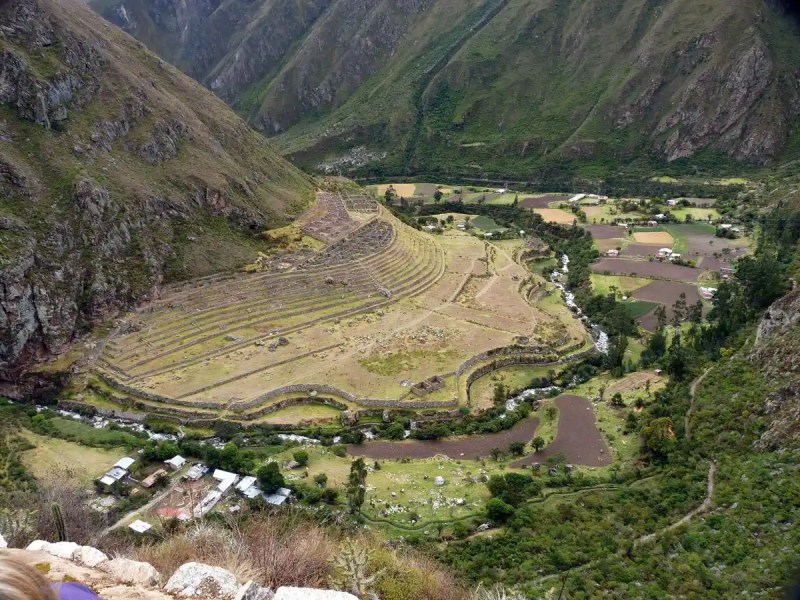
The first day is the gentlest of the trek and works as an acclimatization day. From the starting point at 2,680 meters, the trail gradually climbs through the Urubamba River valley, with open views of the mountains and your first contact with the region’s vegetation. Along the way, you pass the archaeological remains of Llactapata, an ancient agricultural center with terraces and canals that foreshadow what is to come in the following days. The day ends at the Wayllabamba campsite at 3,100 meters. Distance: 14 kilometers. Hiking time: between 6 and 7 hours.

Day 2: Wayllabamba to the Pacaymayu campsite
The second day is the most demanding of the entire route. The trail climbs steadily from the campsite to the Llulluchapampa area, the last point where there are vendors selling water and snacks before the major pass. From there, the final ascent begins toward Warmiwañusca Pass at 4,215 meters, where the air grows thinner and the stone steps seem endless. Reaching the top and seeing the valley on the other side is one of the most intense moments of the trek. The descent to the second campsite at Pacaymayu, at 3,580 meters, is long, but the environment begins to change: the vegetation becomes denser and the climate more humid. Distance: between 10 and 12 kilometers. Hiking time: between 8 and 9 hours.
Day 3: Pacaymayu to Wiñay Wayna
The third day is the richest in archaeological and scenic terms. The trail passes through the sites of Runkurakay, a semicircular structure with extraordinary views over the valley, and Sayacmarca, known as the Inaccessible Town because of its location on a hard-to-reach rocky ridge. Farther along is Phuyupatamarca, the city above the clouds, with original ceremonial fountains still functioning and direct views of the snow-capped mountains on clear days. The final campsite of this day is at Wiñay Wayna, one of the most elaborate and best-preserved archaeological sites on the entire route. Distance: between 9 and 10 kilometers. Hiking time: between 5 and 6 hours.

Day 4: Wiñay Wayna to Machu Picchu through the Sun Gate
The final day begins early in the morning, around 3:00 a.m., to reach the checkpoint before it opens and be able to arrive at the Sun Gate at sunrise. Intipunku is the original entrance to the Inca Trail, and from there you get your first view of Machu Picchu from above, wrapped in mist or illuminated by the morning sun depending on the time of year. From that point, the walk to the citadel takes about 45 additional minutes. Distance: 5 kilometers. Hiking time: between 2 and 3 hours.

Weather and the best time to hike the route
The dry season between May and September offers the best conditions: sunny days, dry trails, and clear skies that allow you to see the snow-capped peaks on the horizon. The nights are cold, especially between June and August when temperatures can drop below 0°C at the higher-altitude campsites, so bringing proper warm clothing is essential.
The rainy season between November and March transforms the landscape with more lush vegetation and the presence of waterfalls and mist that give the route a completely different atmosphere. February is the only month when the trail closes for maintenance and conservation. Hiking the Inca Trail during the low season has a clear advantage: fewer people on the trail, permits that are easier to obtain, and a more peaceful experience at the archaeological sites.

What the Inca Trail package includes
A standard Classic Inca Trail package includes the official trail permit, entrance to Machu Picchu, transportation from Cusco to kilometer 82 at the start and back from Aguas Calientes, a bilingual official guide during the four days, camping equipment with tents and sleeping pads, full meals throughout the trek, and the team of porters who carry the camping gear. Porters can carry up to 5 kilograms of your personal gear in addition to the shared camping equipment.
The cost of a group package with an authorized agency ranges between $700 and $1,200 per person depending on the operator, the size of the group, and the level of service. That price includes practically everything mentioned above and represents one of the best overall values on the market considering that it covers four days of all-inclusive adventure with access to remote archaeological sites.
What to pack in your daypack
- The camping equipment is carried by the porters, but each participant carries a personal backpack during the hike.
- The essentials are enough water for each day and energy snacks for the stretches between meals.
- Layered clothing to adapt to temperature changes throughout the day.
- A rain jacket or poncho, because rain can appear at any time even during the dry season, sunscreen, and insect repellent.
- A headlamp for the early start on the fourth day.
- Trekking poles, which significantly reduce the impact on your knees during long descents.
Acclimatization: the most underestimated detail
Warmiwañusca Pass at 4,215 meters is the highest point of the route and the one that most affects those who are not properly acclimatized. Arriving in Cusco at least two days before starting the hike, walking at altitude during those days, and avoiding alcohol and heavy meals are the most effective measures to reduce the risk of altitude sickness. Coca tea is a real ally throughout the trek and is available at all campsites.
Hike the Inca Trail with Peru Sites
At Peru Sites, we manage Classic Inca Trail permits with the advance planning needed to secure your spot on the date you need. We coordinate transportation, the team of guides and porters, camping equipment, and admission to Machu Picchu in one organized package from Cusco. If permits are already sold out for your travel dates, we also offer alternative trekking routes that reach the citadel through equally impressive trails.

