


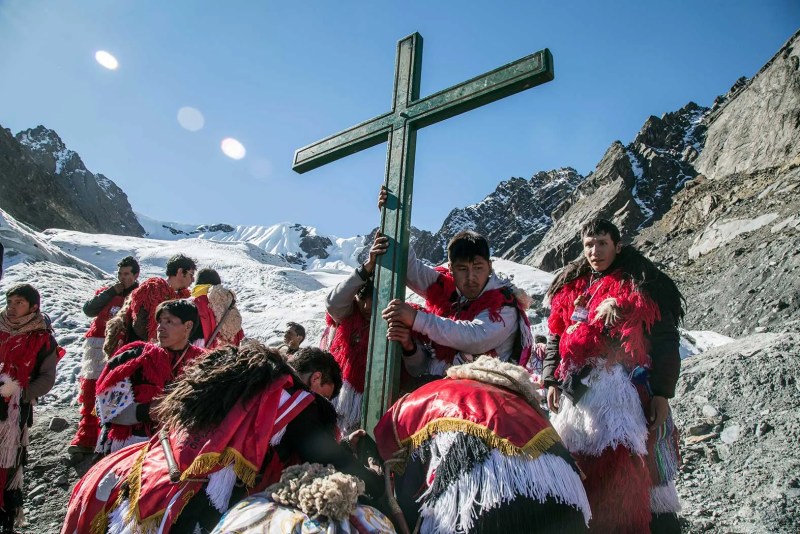
There are celebrations you watch, and there are celebrations you feel in your body. The Lord of Qoyllur Riti belongs to the second kind. To reach the sanctuary, you have to walk for hours at night at over 4,600 meters (15,000+ feet), in intense cold, with the snowcapped Ausangate as a witness. This isn’t a show it’s a real pilgrimage that thousands of people make every year out of faith.
It is likely the largest religious pilgrimage in the Andean world. It brings together pilgrims from communities across southern Peru and Bolivia, dance groups that prepare for months, and devotees who have been fulfilling the same rite year after year for decades. If you go for the first time, you quickly understand why those who have been before keep coming back.
Contents
When it’s celebrated
Dates: May 27–29
The main pilgrimage is concentrated between May 27 and May 29, although dance groups and pilgrims begin arriving in the Sinakara Valley days earlier. The return to their communities stretches into the first days of June, coinciding with the start of Corpus Christi in Cusco.
The dates shift slightly each year because Qoyllur Riti follows the Catholic liturgical calendar specifically the date of Pentecost. It’s best to confirm the exact dates for the current year before planning a trip, although the late-May to early-June window stays consistent.

Where it takes place
Sinakara Valley and the Ausangate glacier
The sanctuary of the Lord of Qoyllur Riti is located in the Sinakara Valley, in the province of Quispicanchis, about 100 kilometers (62 miles) from Cusco. The sanctuary sits above 4,600 meters (15,000+ feet), and Ausangate one of the most sacred mountains in the Peruvian Andes dominates the landscape from anywhere in the valley.
Access to the valley begins in the town of Mawayani, where pilgrims leave their vehicles and start the climb on foot. The hike from Mawayani to the sanctuary takes about two to three hours at a steady pace, with constant elevation gain and thin high-altitude air. Many groups hike up at night to arrive at sunrise.
The origin of the celebration
The legend of the boy and the rock
Tradition says that in the late 1700s, a young shepherd named Mariano Mayta met an unknown boy in the Sinakara Valley, and the two spent days together herding and forming a friendship. When Mariano’s father went looking for him, the boy disappeared, and in the place where he had been, an image of Christ was found imprinted on a rock. Young Mariano died shortly afterward and was buried beside that rock.
The Catholic Church recognized the site as sacred and built a sanctuary around the rock. Over time, devotion grew and absorbed elements of the Andean worldview that existed in the area long before the shepherd’s story. Ausangate was an Apu a sacred mountain long before the Christian narrative arrived, and that overlap of sacred traditions is what gives Qoyllur Riti its unique character.
What the name means
Qoyllur Riti in Quechua means “star snow” or “snow of the star.” The name points to the conditions of the place: the glow of Ausangate’s snow under the night sky whose clarity at that altitude feels unlike anywhere else. That nighttime landscape is inseparable from the pilgrimage experience.

What pilgrims do
The nighttime ascent
Most pilgrim groups hike up at night, leaving Mawayani after midnight to reach the sanctuary before sunrise. The trail gains elevation steadily, and the cold intensifies as you climb. Groups sing, pray, and play music throughout the ascent, giving the journey an atmosphere completely different from a typical mountain hike.
The headlamps of hundreds of groups moving at the same time across the valley slopes create a scene many describe as one of the most striking images of their entire experience in the Andes. It’s not something you forget easily.
The vigil at the sanctuary
Once they arrive, pilgrims spend hours keeping vigil before the image of the Lord of Qoyllur Riti. People pray, sing, and dance, and many groups remain in prayer all night. Inside the sanctuary the temperature is extremely low, and the space fills with people, candles, and the sound of bands playing nonstop outside.
The nighttime vigil is the most spiritually intense moment of the pilgrimage. Some devotees cry when they reach the image, others dance in a state of collective ecstasy, and others simply stand still for a long time. Everyone experiences it differently, but they share the same space and the same cold.
The climb to the glacier
Before sunrise on the final day, several groups climb up to Ausangate’s glaciers to bring back a block of ice, which they carry to their communities as a symbol of blessing and abundance for the year. Climbing to the glacier at that altitude and at that hour is a major physical test one pilgrims undertake in a state of devotion.
This custom has Andean roots older than Catholicism: ice from sacred mountains has long been seen as a source of power and protection in the Andean worldview. Its inclusion in the Qoyllur Riti ritual is another example of the blending of traditions that defines this celebration.

The “nations” and the dances
Organization by “nations”
Pilgrims don’t arrive at Qoyllur Riti as loose individuals they come organized in “nations,” groups that represent a specific community, province, or district. Each nation has its own dancers, music, and outfits, and representing their community during the pilgrimage is a responsibility taken very seriously.
Rivalry between nations is friendly, but real. Each group wants to show the best outfits, the strongest dancers, and the most powerful music. That spirit of respectful competition between communities is one of the forces that sustains the artistic quality and dedication each group brings after months of preparation.
The ukuku: guardians of the pilgrimage
The ukuku are the most distinctive characters at Qoyllur Riti. They wear wool masks that fully cover the face and costumes that represent the Andean spectacled bear ukuku in Andean mythology a being that lives between the human world and the spirit world. During the pilgrimage they act as guardians of order, with real authority to correct inappropriate behavior and organize groups.
The ukuku are also the ones who make the most extreme climb to the glacier. Their role blends practical organizational functions with deep spiritual symbolism: they are intermediaries between the world of the living and the world of the Apus, the sacred mountains. Their presence gives Qoyllur Riti an element found in no other Andean celebration.
How to get to Sinakara Valley
Your starting point is Cusco. From there, you need to reach the town of Mawayani, about 100 kilometers (62 miles) away via the road that goes through Urcos and Ocongate. The drive takes around three hours. From Mawayani, the hike up to the sanctuary begins and takes an additional two to three hours.
During the pilgrimage days, there is public transportation and more frequent shared vans (colectivos) from Cusco to Ocongate and Mawayani than usual. Many Cusco tour agencies offer trips that include transportation, a guide, and in some cases porters for those who don’t want to carry their own backpack during the climb.
Tips for pilgrims and visitors
Acclimatization is non-negotiable
The sanctuary sits above 4,600 meters (15,000+ feet). Anyone who arrives in Cusco and then tries to go up to Qoyllur Riti the very next day without time to adjust is very likely to experience severe altitude sickness. At a minimum, it’s recommended to spend two full days in Cusco before the ascent avoiding intense physical activity, drinking plenty of water, and sleeping well.
At that altitude, altitude-sickness symptoms are stronger than in Cusco: severe headache, nausea, shortness of breath, and extreme fatigue can appear even in people who had no issues in the city. If your body isn’t responding well when you reach Mawayani, it’s better not to continue and not to force it.
Essential clothing and gear
Nighttime temperatures in the Sinakara Valley drop several degrees below freezing during the pilgrimage. Thermal layers, a down jacket (or similar), gloves, a warm hat, and trekking shoes with good traction are the minimum gear for safely spending the night in the valley. Anyone who underestimates the cold pays for it during the long hours of vigil.
It’s also smart to bring a headlamp with fresh batteries, a basic first-aid kit including altitude-sickness medication, enough water and snacks for the ascent and the vigil, and sunscreen for the daytime descent. There are a few food stalls in the valley, but options are limited and prices are higher than in Cusco.
Respect is the rule
Qoyllur Riti is an active religious pilgrimage, not a cultural festival to observe. Visitors are welcome, but should behave like guests: don’t interrupt rituals to take photos, don’t cut through dance groups while they’re performing, don’t speak loudly near the sanctuary during prayer moments, and always ask permission before photographing pilgrims or dancers up close.
The ukuku have real authority to call out inappropriate behavior during the pilgrimage and they do. It isn’t symbolic authority; it’s an order-keeping role that pilgrims recognize and respect. Visitors who arrive with a respectful attitude and genuine curiosity are welcomed. Those who arrive expecting a spectacle may have an uncomfortable experience.

Frequently asked questions
How many people attend Qoyllur Riti each year?
Estimates vary by source, but it’s often said that between 50,000 and 100,000 pilgrims pass through the sanctuary during the main days of the celebration. It’s hard to pin down an exact number because groups arrive at different times and the flow is constant over several days. What’s certain is that Sinakara Valley hosts one of the largest annual human gatherings in the Andes.
Can you camp in the valley during the pilgrimage?
Yes and it’s the usual way to participate. Most pilgrims bring a tent or sleep outdoors with sleeping bags during the days they spend in the valley. There are designated camping areas near the sanctuary. Sub-freezing nighttime temperatures make a good-quality sleeping bag and enough thermal clothing essential for spending the night outside.
Do you have to be Catholic or religious to attend?
No there’s no faith requirement to attend as a visitor. Many people go to Qoyllur Riti out of cultural or anthropological interest, or simply genuine curiosity about one of the most intense expressions of Andean religiosity. What is required of every visitor believer or not is respect for what is happening and for the people participating with real faith.
How is Qoyllur Riti different from Inti Raymi?
They are completely different in character, scale, and meaning. Inti Raymi is a theatrical reenactment of an Inca ritual an organized cultural event with actors, staging, and paid tickets. Qoyllur Riti is a real religious pilgrimage in which thousands of people hike up a mountain above 4,600 meters (15,000+ feet) out of faith. One is watched; the other is lived. That difference says it all.

